

naturasounds
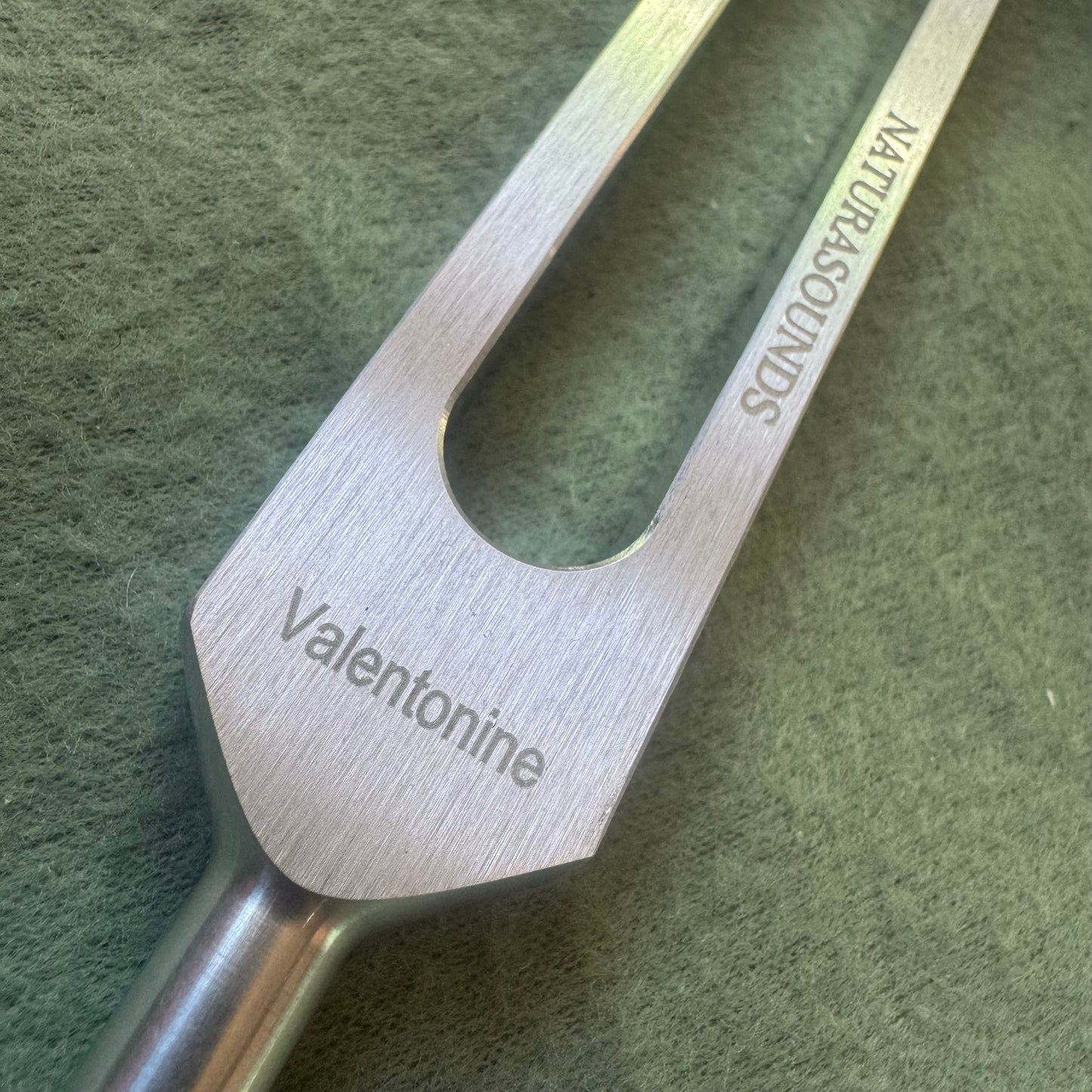
Valentonine Tuning Fork - F#
Valentonine Tuning Fork - F#
Couldn't load pickup availability
We are pleased to present an original therapeutic tuning fork linked to sleep activity and its regulation, which several therapists have asked us to produce.
We calculated its frequency based on the work of Professor Jean-Bernard Fourtillan.
Its frequency is around 89 Hz (calculated from its chemical formula C15H15N2O with the Einstein/Planck equation) and its note is an F# on a 432 Hz A base.
It stimulates the body to achieve restorative physiological sleep.
More significant effects are observed than with the melatonin frequency.
Here is an excerpt from an interview with Professor Fourtillan to better understand his discovery of Valentonin and its properties.
"The discovery of Valentonin was the key to identifying the Wake-Sleep system.
I had first measured melatonin and suspected that it was not the sleep hormone, as was commonly believed.
To measure melatonin in blood plasma, a technique coupling gas chromatography with mass spectrometry is used. To chromatograph non-volatile melatonin, it must be brought into a gaseous state, as all chemists know.
It is therefore transformed into a volatile pentafluoroacylated derivative, which is a tricyclic derivative with a beta-carboline nucleus. These words are complex.
My chemist friends know that β-carboline (9H-pyrido[3,4-b]indole) is an aromatic amine composed of 3 rings, hence tricyclic. Its basic skeletal nucleus belongs to the class of compounds called β-carbolines.
β-carboline alkaloids are widespread in plants and animals and act in astonishing ways. They play an important pharmacological role and are primarily responsible for the psychedelic effects of certain lianas in the Amazon. Several β-carbolines have been isolated from a plant called Peganum Harmala, psychostimulant at low doses, and hallucinogenic at high doses.
It was a beautiful day in April 1994, while reflecting on the mechanism of this derivatization reaction forming a tricyclic derivative with a beta-carboline nucleus, that I understood, in a few seconds, how the sleep hormone is formed. A true "revelation".
I knew that, in the pineal gland, melatonin is formed by acetylation of serotonin under the action of an enzyme, N-acetyltransferase; and I suddenly understood that this enzymatic acetylation continued in reality.
According to the same formation mechanism as N-pentafluoroacylated beta-carboline (N-CO-C2F5), obtained by a chemical reaction of pentafluoroacylation of melatonin, a biochemical enzymatic acetylation reaction of melatonin, in the pineal gland, leads to an N-acetylated beta-carboline (N-CO-CH3).
I was convinced that this N-acetylated beta-carboline, which I had before my eyes, was the sleep hormone. I named it "Valentonin", and I will tell you why.
In the days that followed, after rapidly synthesizing Valentonin, I was able to demonstrate its hypnotic properties in dogs, a nocturnal sleeping animal like humans.
It provides restorative physiological sleep, unlike the sleeping pills available on the market, such as benzodiazepines and related drugs, which provide non-restorative anesthetic sleep, with many adverse effects.
We demonstrated the presence of Valentonin in the pineal gland during the night, in different animals (chickens, dogs...). You will find the details of this discovery in my book, on page 38, Pesp 4: the circumstances of my discovery of Valentonin, the sleep hormone."
To learn more, here is the link to Professor Fourtillan's interview about valentonin:
https://www.professeur-joyeux.com/2016/11/29/interview-parkinson-alzheimer/
Partager