
naturasounds
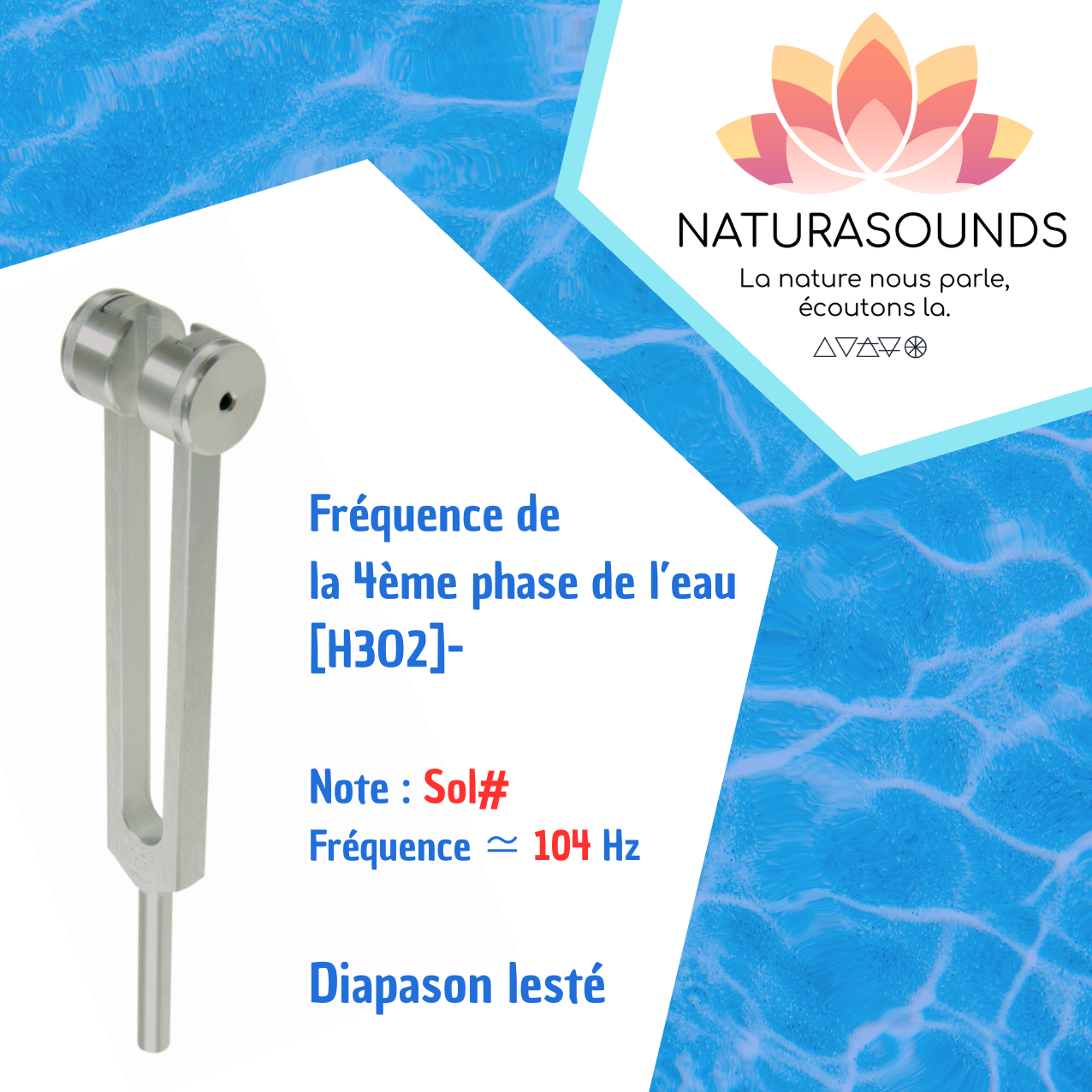
H3O2 Water Tuning Fork, non-weighted 104.40 Hz | EZ Water Structured Water
H3O2 Water Tuning Fork, non-weighted 104.40 Hz | EZ Water Structured Water
Couldn't load pickup availability
Molecular Frequency of H₃O₂⁻ Water
4th Phase Water - EZ (Exclusion Zone) Structured Water
Application in Vibrational Sound Therapy
🔬 MOLECULAR IDENTITY
Chemical Formula [H₃O₂]⁻
- Fourth phase water / EZ water / Structured water (Exclusion Zone Water - EZ Water)
Theoretical Properties According to Dr. Gerald Pollack
Discovery : When it touches most surfaces, water transforms into what is called EZ water (Exclusion Zone), also known as structured water or fourth-phase water, with the formula [H₃O₂]⁻
Distinctive characteristics :
- Structure : Hexagonal crystalline structure between liquid water and solid
- Electrical charge : Negatively charged
- Formation : Forms in a space called the exclusion zone (EZ) which excludes particles and solutes
- Calculated molecular mass : 35.0213 g/mol (2H + 1.5O per molecule)
- H:O ratio : 3:2 (instead of 2:1 for H₂O)
Scientific Context
Dr. Gerald Pollack :
- Professor of bioengineering at the University of Washington, he identified EZ water and received the 1st Emoto Peace Prize
- Author of "The Fourth Phase of Water" (2013) and "Cells, Gels and the Engines of Life" (2001)
🎵 EINSTEIN-PLANCK FUNDAMENTAL FREQUENCY
FUNDAMENTAL FREQUENCY [H₃O₂]⁻ : 104.40 Hz
(Calculation with adjustment: 104.405... Hz, i.e., a slightly different transposition)
This frequency represents the vibrational energy signature of EZ structured water, distinct from conventional H₂O water (107.40 Hz).
🌊 H₂O vs H₃O₂⁻ DIFFERENCES
Comparison of the Two Forms of Water
| Characteristic | H₂O (Classic Water) |
[H₃O₂]⁻ (EZ Water) |
|---|---|---|
| Formula | H₂O | H₃O₂⁻ |
| Molecular mass | 18.015 Da | ~35.021 Da |
| Frequency (Hz) | 107.40 | 104.40 |
| Structure | Disordered liquid | Hexagonal crystalline |
| Charge | Neutral | Negative |
| State | Classic liquid phase | 4th phase (between liquid and solid) |
| Formation | Spontaneous | At the contact of hydrophilic surfaces |
| Formation energy | Natural | Requires radiant energy (3 µm infrared light) |
Frequency difference : 107.40 Hz - 104.40 Hz = 3 Hz
- Represents approximately 49 cents (almost a quarter tone)
- This subtle difference creates a perceptible beat
🎼 HARMONIC SERIES [H₃O₂]⁻
Derived Frequencies (Octaves of 104.40 Hz)
Infrasonic Frequencies :
- 26.10 Hz (H-2) : Two octaves below
- 52.20 Hz (H-1) : One octave below
Fundamental Frequency :
- 104.40 Hz (H0) : Master Fundamental - EZ water signature
Upper Harmonics :
- 208.80 Hz (H1) : First octave - G♯3
- 417.60 Hz (H2) : Second octave - G♯4
- 835.20 Hz (H3) : Third octave - G♯5
Musical and Historical Correspondence
417.60 Hz corresponds to an A♭4 / G♯4 :
- Frequency very close to the German Baroque pitch (415-417 Hz)
- Johann Sebastian Bach and Johann Pachelbel played with this pitch, and Pachelbel's Canon should be played at the 415/417 Hz pitch rather than 432 Hz
- If we calculate a Zarlino natural scale with C at 7.83 Hz (Schumann frequency) as the base, we get an A4 at 417.60 Hz.
- The sacred Solfeggio also includes the 417 Hz frequency
Analogy with music :
- Since 429.62 Hz (H₂O) is close to 432 Hz
- 417.60 Hz (H₃O₂⁻) is close to 415 Hz (German Baroque)
- Similar difference between the two pairs: approximately 12-17 Hz
🔬 THE SCIENCE OF EZ WATER (Dr. Pollack)
Discovery and Properties
Formation of the Exclusion Zone
Absorbed radiant energy splits water molecules; the negative part constitutes the building block of the EZ, while the positive part binds to water molecules to form free hydronium ions that diffuse into the water
Mechanism :
- Hydrophilic surface + water → Start of EZ formation
- Infrared light (especially 3 µm) → Energy
- H₂O splitting → H₃O₂⁻ (negative) + H₃O⁺ (positive)
- Exclusion zone forms and excludes solutes/particles
Role of Light
The energy to build the water structure comes from the sun. Radiant energy converts ordinary water into ordered water. All wavelengths from UV to visible to infrared can build this ordered water. Near-infrared energy is the most effective
Analogy with photosynthesis :
- This process resembles the first step of photosynthesis where energy from the sun splits water molecules
- Creation of a "battery" with separated charges
- Energy storage in the water structure
Location in the Human Body
Where can EZ water be found?
EZ water forms naturally at the contact of hydrophilic surfaces, which are present everywhere in the body:
- Cell membranes : Water-protein interface
- Blood vessels : EZ layer along the walls
- Connective tissues : Collagen matrices
- Cell cytoplasm : Interactions with proteins
- Joints : Structured synovial fluid
- Fascia : Organized interstitial water
Implication : The water in the cells remains in place because it is absorbed into the protein surfaces
🎯 CHARACTERISTICS OF THE 104.40 Hz FREQUENCY
Acoustic Properties
Frequency range : Audible infrasound / Deep bass
- Perception : Body vibration + clear audible component
- Musical octave : Between G♯2 (103.8 Hz) and A2 (110 Hz), close to G♯2
- Wavelength : ~3.29 meters in air
- Proximity to H₂O : Only 3.01 Hz difference (subtle beat)
Specific Resonance
Targeting structured water :
- Specific frequency for water in contact with biological surfaces
- Resonates with water of cellular interfaces
- Harmonizes water in connective tissues and fascia
Therapeutic differentiation :
- H₂O (107.41 Hz) : Free water, circulation, general hydration
- [H₃O₂]⁻ (104.40 Hz) : Structured water, interfaces, biological matrices
🎵 THERAPEUTIC APPLICATIONS
[H₃O₂]⁻ Tuning Fork - 104.40 Hz Frequency
Technical Specifications
- Type : Weighted tuning fork for deep vibration
- Precise frequency : 104.40 Hz (±0.1 Hz)
- Material : High-quality medical-grade alloy
- Resonance duration : 15-20 seconds
- Weight : 110-150g (optimal tissue penetration)
- Length : 13-15 cm
Potential Therapeutic Effects
Optimization of biological interfaces :
- Improved cell-environment communication
- Structuring of interstitial water
- Fluidity of fascia and connective tissues
Cellular energy charge :
- Separated charges resemble a battery capable of delivering energy
- Optimized electrical potential
- Increased cellular vitality
Exclusion of toxins :
- EZ water deeply excludes solutes
- Facilitation of tissue drainage
- Purification of intercellular spaces
Joint lubrication :
- Improvement of structured synovial fluid
- Reduction of friction
- Restored joint flexibility
Fascia health :
- Cell cytoplasm is gel-like rather than an ordinary aqueous solution
- Hydration of collagen matrices
- Optimized tissue elasticity
📋 USAGE PROTOCOLS
Protocol 1: Activating Bodily EZ Water
Objective : Stimulate the formation of structured water in tissues
Frequency : 104.40 Hz
-
Phase 1 - Fascia (5 min)
- Back (paravertebral areas): Activation of large fascial sheets
- Slow movements along the spine
-
Phase 2 - Connective tissues (4 min)
- Major joints (knees, hips, shoulders)
- Prolonged contact for deep penetration
-
Phase 3 - Cellular interfaces (3 min)
- Abdomen (digestive system)
- Thymus area (immunity)
Total duration : 12 minutes Frequency : 3 times per week Best time : Morning or after sun exposure
Protocol 2: H₂O + [H₃O₂]⁻ Synergy
Objective : Complete harmonization of all forms of bodily water
This sequence combines both frequencies for a global effect:
-
H₂O at 107.41 Hz (4 min)
- Harmonization of free water, circulation
- Zones: feet, heart, forehead
-
H₃O₂⁻ at 104.40 Hz (4 min)
- Structuring of tissue water
- Zones: fascia, joints, abdomen
-
Natural beat (2 min)
- Rapid alternation of both frequencies
- Creates a 3.01 Hz beat effect
- Zone: solar plexus (integration)
Total duration : 10 minutes Effect : Complete harmonization of free water + structured water
Protocol 3: Deep Fascial Therapy
Objective : Release of fascial restrictions
Frequency : 104.40 Hz ([H₃O₂]⁻) exclusively
- Zones : Myofascial chains (back, legs, arms)
- Duration : 6-8 minutes per chain
-
Technique :
- Gliding pressure along the fascia
- Hold on tension points (30-60 sec)
- Following the fascial line
Indications : Mobility restrictions, chronic myofascial pain, posture
Protocol 4: Baroque Harmonic (417.60 Hz)
Objective : Subtle work on the H2 harmonic
Frequency : 417.60 Hz (2nd octave of [H₃O₂]⁻)
Use an unweighted 417.60 Hz tuning fork for subtle energetic work:
- Zones : Around the body (aura), acupuncture points
- Duration : 5-7 minutes
- Technique : No direct contact, 2-5 cm from the skin
Connection : Vibration in the field of Baroque compositions (Bach, Pachelbel)
🔬 SCIENTIFIC DEBATE AND LIMITATIONS
Controversy Regarding EZ Water
The Skeptics' Position
Chemists question the long-term existence of [H₃O₂]⁻:
If water were to change in a certain way into an [H₃O₂]⁻ form, a simple calculation shows that transforming two H₂O molecules into one [H₃O₂]⁻ would leave an extra hydrogen atom floating. We would expect to see this hydrogen released as H₂ gas.
The rapid movement of hydrogen atoms and the blinking of hydrogen bonds mean that any structure in EZ water would dissipate very quickly. Water forgets its neighbors in picoseconds and exchanges its hydrogen atoms in milliseconds.
Pollack's and Supporters' Position
- Repeated experimental observations of the exclusion zone
- Measurements of negative electrical charge in the EZ zone
- Visible effects of infrared light on the expansion of the EZ
- More than 200 scientific publications by Dr. Pollack
It is important to understand that the observer influences the experiment based on their beliefs; therefore, if someone does not believe or is not neutral, they will bias the experiment.
Current Situation
The scientific community remains divided. Current main limitations include: limited replication - experiments have not been adequately replicated by other independent laboratories.
💎 PRAGMATIC APPROACH
Use in Sound Therapy
Even though controversy persists regarding the durability of [H₃O₂]⁻, the use of the 104.40 Hz frequency remains relevant for several reasons:
✅ Rigorously calculated frequency :
- Hypothetical molar mass of H₃O₂⁻: 35.0213 Da
- Correct application of the Einstein-Planck equation
- Mathematical coherence
✅ Therapeutic differentiation :
- Allows targeting tissues differently than with 107.41 Hz
- Natural beat with H₂O (3.01 Hz) is potentially beneficial
- Distinct frequency range (104 vs 107 Hz)
✅ Complementary approach :
- Combined use of H₂O + [H₃O₂]⁻ for complete coverage
- Enrichment of the therapeutic palette
- Respect for the precautionary principle (non-invasive)
✅ Historical connection :
- Link to the Baroque tuning fork (417 Hz)
- Anchoring in the Western musical tradition
- Cultural and historical resonance
🌐 COMPARISON OF WATER FREQUENCIES
| Water Type | Formula | Mass (Da) | Frequency (Hz) | Context |
|---|---|---|---|---|
| Bulk water | H₂O | 18.015 | 107.41 | Free water, circulation |
| Structured EZ water | [H₃O₂]⁻ | ~35.021 | 104.40 | Interfaces, fascia |
| Difference | - | - | 3.01 Hz | Subtle beat |
Frequency ratio : 107.41 / 104.40 = 1.0288
- Slightly higher than 1 (approx. 2.86% higher)
- Creates a musical interval of approx. 48 cents (nearly a quarter-tone)
📚 REFERENCES
Primary Sources
-
Dr. Gerald Pollack - University of Washington
- "The Fourth Phase of Water: Beyond Solid, Liquid, and Vapor" (2013)
- "Cells, Gels and the Engines of Life" (2001)
- Over 200 scientific publications
-
NATURASOUNDS (Renaud Ruhlmann)
- Research on H₃O₂⁻ following the discovery of H₂O in 2020
- Calculation of 104.41 Hz / 417.60 Hz frequency
- Development of therapeutic tuning forks
-
Pollack Laboratory
- Research on EZ water and the fourth phase
- Studies on the effects of infrared light
- Observations of the exclusion zone
Critiques and Debates
-
University of New South Wales (Australia)
- Critique of structured water and chemical analysis of H₃O₂
- Discussion on the stability of water structures
-
Aquaphotomics Studies
- Near-infrared spectroscopy
- Temporary effects of frequencies on water
💧 CONCLUSION
The frequency 104.40 Hz represents the hypothetical vibrational signature of fourth-phase water [H₃O₂]⁻, as proposed by the work of Dr. Gerald Pollack.
Key points :
- ✅ Rigorous mathematical calculation based on theoretical molar mass
- ⚠️ Existence of stable [H₃O₂]⁻ contested by some chemists
- ✅ Documented experimental observations of the exclusion zone (EZ)
- ✅ Non-invasive application in sound therapy without risk
- ✅ Complementarity with H₂O (107.40 Hz) for a global approach
Usage recommendations :
- Use as a complement to H₂O (107.40 Hz)
- Target connective tissues, fascia, joints
- Protocols of 3 to 5 sessions per week for optimal effects
- Synergistic exposure to natural light (infrared)
Philosophy : Whether [H₃O₂]⁻ exists permanently in the body or not, the 104.40 Hz frequency offers a distinct complementary therapeutic tool, resonating with historical musical traditions (baroque) and allowing for a holistic approach to bodily water in all its forms.
Water remains mysterious, and exploring its multiple facets through sound vibration constitutes an innovative approach rooted in the quest to understand this vital element.
Technical sheet based on the work of Dr. Gerald Pollack (University of Washington) and calculations of sonic molecular chemistry (NATURASOUNDS). The exact nature of [H₃O₂]⁻ is subject to debate in the scientific community. Therapeutic application pertains to the field of vibrational sound therapy.
Does not replace professional medical advice.
Partager