
naturasounds
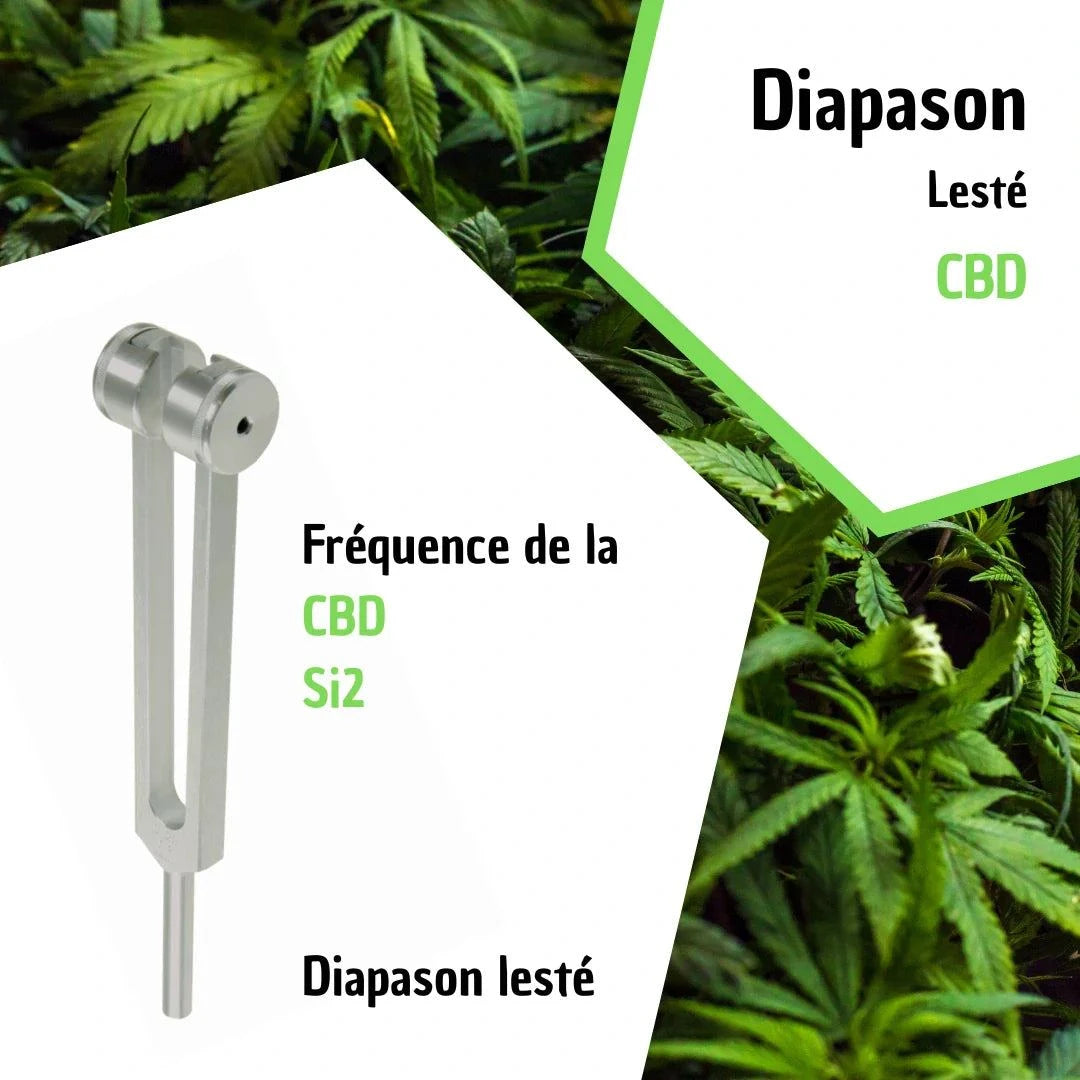
Diapason CBD - Relaxation & Serenity
Diapason CBD - Relaxation & Serenity
Couldn't load pickup availability
Molecular Frequency of Cannabidiol (CBD)
Non-Psychoactive Phytocannabinoid - Application in Vibrational Sound Therapy
🔬 MOLECULAR IDENTITY
Chemical Formula
C₂₁H₃₀O₂ - Cannabidiol (CBD)
IUPAC Nomenclature
2-[(1R,6R)-3-methyl-6-(1-methylethen]
yl)-2-cyclohexen-1-yl]-5-pentyl-1,3-benzenediol
Fundamental Physico-Chemical Properties
- Molecular formula : C₂₁H₃₀O₂
- Molecular mass : 314.464 g/mol (virtually identical to THC: 314.469 g/mol)
- Structure : Bicyclic molecule (vs. tricyclic for THC)
- Appearance Colorless crystals or white powder
- Solubility : Lipophilic (soluble in fats/oils)
- Melting point ~66°C
- Oral bioavailability : 13-19% (low due to first-pass hepatic metabolism)
- Elimination half-life ~9 hours
Natural Origin
CBD is a major phytocannabinoid extract of Cannabis sativa L., representing up to 40% of the plant extract
Discovery :
- Isolated from cannabis in the late 1930s
- Structure and stereochemistry elucidated in 1963
- First pharmacological studies in the 1970s
🎼 CBD HARMONIC SERIES
Derived Frequencies (Octaves of 58.59 Hz)
Infrasonic Frequencies :
- 14.65 Hz (H-2): Two octaves below
- 29.30 Hz (H-1): An octave below
Fundamental Frequency :
- 58.59 Hz (H0): Fundamental mistress - CBD Signature
Higher Harmonics :
- 117.18 Hz (H1): First octave - B♭2
- 234.36 Hz (H2): Second octave - B♭3
- 468.72 Hz (H3): Third octave - B♭4
- 937.44 Hz (H4): Fourth octave - B♭5
Musical Positioning
The frequency is 58.59 Hz is located between:
- Si1 (61.74 Hz) and The♯1 (58.27 Hz)
- Very close to Si♭1 (58.27 Hz) in the tempered range
Sound character : Very deep bass, predominantly bodily vibration, at the limit of clear auditory perception.
🌿 CBD: PHARMACOLOGY AND EFFECTS
Pharmacological Profile
CBD is the main non-psychoactive component of Cannabis sativa, exhibiting multiple actions: anticonvulsant, sedative, hypnotic, antipsychotic, anti-inflammatory and neuroprotective.
Differences between CBD and THC
| Characteristic | CBD (C₂₁H₃₀O₂) | THC (C₂₁H₃₀O₂) |
|---|---|---|
| Molecular mass | 314.464 g/mol | 314.469 g/mol |
| Structure | Bicyclic | Tricyclic |
| Psychoactive effect | No (no euphoria) | Yes (high effect) |
| CB1 Affinity | Weak (negative allosteric modulator) | Forte (powerful partial agonist) |
| Legality | Wide (legal in many countries) | Restricted (illegal in most countries) |
The molecular mass is practically identical, but the different molecular configuration explains the divergent effects.
Mechanisms of Action
Interaction with the Endocannabinoid System
CB1 and CB2 receivers :
- CBD binds with a low affinity to CB1 and CB2 receptors
- Acts as negative allosteric modulator CB1
- Changes the shape of the CB1 receptor, weakening its ability to bind to THC
Modulating effect CBD reduces some of the negative effects of THC by decreasing anxiety, paranoia, and short-term memory problems.
Other Molecular Targets
Several molecular targets have been proposed for CBD:
- Serotonergic receptors (5-HT)
- Vanilloid receptors (TRPV)
- GPR55 Receivers
- Anandamide system (inhibition of its degradation)
🎯 FREQUENCY CHARACTERISTICS 58.59 Hz
Acoustic Properties
Frequency range : Audible infrasound / Sub-bass
- Perception Very pronounced body vibration + low auditory perception
- Musical Octave : Close to B♭1 (58.27 Hz)
- Wavelength ~5.86 meters in the air
- Tissue penetration Maximum, resonates throughout the body
Endocannabinoid Resonance
Theoretical targeting :
- Harmonization of endocannabinoid system (ECS)
- Balancing CB1 (brain) and CB2 (periphery) receptors
- Supporting homeostasis overall body
The endocannabinoid system :
- Regulates mood, pain, appetite, sleep, inflammation
- Present throughout the body (brain, organs, tissues, immune cells)
- Endogenous ligands: anandamide and 2-AG
🎵 THERAPEUTIC APPLICATIONS
Diapason CBD - Frequency 58.59 Hz
Technical Specifications
- Kind Weighted tuning fork for very deep vibrations
- Precise frequency : 58.59 Hz (±0.1 Hz)
- Material Heavy medical alloy (iron-tungsten or high-density steel)
- Resonance duration 15-20 seconds
- Weight 150-200g (maximum penetration)
- Length : 15-17 cm
Potential Therapeutic Effects
Based on the known properties of CBD:
Calm and relaxation :
- Anxiety reduction
- Stress management
- Deep muscle relaxation
- Sleep improvement
Anti-inflammatory action :
- Relief from chronic pain
- Reduction of tissue inflammation
- Joint support
- Muscle recovery
Neuroprotective effects :
- Mental clarity
- Neural protection
- Mood regulation
- Emotional balance
General homeostasis :
- Endocannabinoid system balance
- Appetite/sleep/mood regulation
- Adapting to stress
- Global Resilience
📋 USAGE PROTOCOLS
Protocol 1: Deep Relaxation and Anti-Stress
Objective : Soothing of the nervous system
Frequency : 58.59 Hz
-
Phase 1 - Anchoring (4 min)
- Soles of the feet: Rooting
- Base of the column: Security
-
Phase 2 - Central nervous system (5 min)
- Solar plexus: Emotional center
- Heart: Cardiac calming
- Base of the skull: Mental relaxation
-
Phase 3 - Integration (3 min)
- Top of the skull: Connection
- Synchronized deep breathing
Total duration : 12 minutes Optimal moment Evening, before bedtime Frequency Daily for 21 days
Protocol 2: Chronic Pain Management
Objective Soothing of pain and inflammation
Frequency : 58.59 Hz
- Direct application On painful areas
- Duration 5-7 minutes per zone
-
Technical :
- Prolonged contact
- Very slow circular movements
- Conscious breathing
Common areas :
- Lower back (back pain)
- Cervical (neck tension)
- Joints (knees, hips, shoulders)
- Muscles (fibromyalgia)
Frequency 2-3 times a day Complement Gentle stretching, local heat
Protocol 3: Emotional Balance
Objective : Harmonizing mood and emotions
Frequency : 58.59 Hz + 52.20 Hz (H3O2-)
-
52.20 Hz (5 min) - Low octave: Deep emotional grounding
- Solar plexus
- Heart area
-
58.59 Hz (5 min) - Fundamental: Balancing
- Energy points along the spine
- Crown chakra (top of the head)
Total duration : 10 minutes Indication Anxiety, mild depression, mood swings Frequency Once a day, 5 days a week
Protocol 4: Sports Recovery
Objective Reduction of post-exercise inflammation
Frequency : 58.59 Hz
Post-workout sequence :
- Muscles used (5 min)
- Joints (3 min)
- Lumbar region (2 min)
- Solar plexus - integration (2 min)
Timing Within 2 hours of exertion Synergy Hydration + stretching + rest
💎 THE ENCOURAGE EFFECT
Cannabinoid Synergy
The concept of " whole plant medicine" suggests that the cannabinoids and other active compounds in cannabis have a combinatorial effect , also called entourage effect
In sound therapy, this could be translated as :
- Combined use of multiple frequencies (CBD + THC + CBG)
- Creation of a harmonic "frequency cocktail"
- Mutual reinforcement of vibrational effects
Suggested Frequency Combinations
CBD (58.59 Hz) + GABA (76.85 Hz)
Synergy Dual relaxing/anxiolytic action Difference : 18.26 Hz (alpha/theta beat) Application : Maximum anti-stress protocol
CBD (58.59 Hz) + H₂O (107.40 Hz)
Synergy Hydration + anti-inflammation Sequence H₂O (hydration) → CBD (soothing) Application Sports recovery, joint pain
CBD (58.59 Hz) + Iodine I₂ (94.57 Hz)
Synergy Relaxation + metabolism Application General mind-body balance
🔬 SCIENTIFIC BASIS AND LIMITATIONS
Established Pharmacological Properties
This is what has been scientifically proven for the chemical CBD :
CBD exhibits analgesic, anticonvulsant, muscle relaxant, anxiolytic, antipsychotic, neuroprotective, anti-inflammatory, and antioxidant properties.
- Efficacy in refractory epilepsy (Epidiolex®, approved drug)
- Anxiety reduction in several clinical studies
- Anti-inflammatory effects demonstrated in vitro and in vivo
- Favorable safety profile (few side effects)
Extrapolation to Sound Therapy
This is a hypothesis :
- Does the 58.59 Hz frequency reproduce the effects of chemical CBD?
- Is there a specific "vibrational memory" associated with CBD?
- Does the endocannabinoid system respond to acoustic frequencies?
Transparency :
- ❌ No clinical studies specifically on the 58.59 Hz frequency
- ✅ Rigorous mathematical calculation of frequency
- ✅ Documented effects of low-frequency vibrations (relaxation, circulation)
- ⚠️ Supposed mechanism of action, not proven
⚠️ PRECAUTIONS AND CONSIDERATIONS
Nature of the Approach
IMPORTANT This sound therapy approach:
- ✅ Is NON-INVASIVE and without the addition of cannabidiol
- ✅ Do not use NONE substance extracted from cannabis
- ✅ Uses only acoustic frequencies
- ✅ Is LEGAL everywhere (no controlled substances)
Crucial Distinction
⚠️ This method does NOT use chemical CBD
- No cannabidiol molecules ingested or applied
- No cannabis derivative products
- Vibrational action only
- No risk of drug interaction related to CBD
What is Used
✓ acoustic frequency 58.59 Hz derived from the mass of CBD
✓ Tuning forks or frequency generators
✓ Mechanical vibrations non-invasive
✓ No positive screening test (no substance)
Limits and Honesty
Cannot replace :
- Medical CBD for severe epilepsy
- The prescribed anxiolytic treatments
- Anti-inflammatory drugs in cases of acute illness
- Professional psychological support
Can be used as :
- A complementary approach to well-being
- Relaxation and stress management tool
- Vibrational support for prevention
- Muscle recovery aid
📚 REFERENCES
Primary Sources
-
PubChem / NIST
- CBD molecular weight: 314.464 g/mol
- Chemical structure C₂₁H₃₀O₂
-
NATURASOUNDS (Renaud Ruhlmann)
- Calculating the frequency of 58.59 Hz for CBD
- Einstein-Planck application
-
CBD Pharmacology
- Clinical studies on anxiolytic and anti-inflammatory effects
- Mechanisms of action on the endocannabinoid system
Therapeutic Context
- Endocannabinoid system Physiology and role in homeostasis
- Effects of CBD Systematic reviews and meta-analyses
- Vibrational therapies Effects of low frequencies on the body
💚 CONCLUSION
The frequency 58.59 Hz represents the vibrational signature of cannabidiol (CBD), calculated from its molecular mass via the Einstein-Planck equation.
Key points :
- ✅ Rigorous scientific calculation based on C₂₁H₃₀O₂ (314.464 g/mol)
- ✅ Non-invasive, legal and risk-free application
- ✅ Theoretical targeting of the endocannabinoid system
- ✅ Relaxing, anti-stress and soothing effects
- ⚠️ No proven equivalence with chemical CBD
Usage recommendations :
- Approach to complementary well-being
- Protocols daily for stress management (21 days)
- Combinations possible with H₂O, GABA, I₂
- Does not replace not medical treatment
CBD, a molecule of relaxation and balance, offers us, through its vibrational frequency, a path to profound calm. At 58.59 Hz, it invites us to slow down, to ground ourselves, and to reconnect with our center.
Technical data sheet established based on physicochemical calculations (NATURASOUNDS) and pharmacological data on CBD. Therapeutic application within the field of vibrational sound therapy. No cannabinoids or cannabis-derived substances are used in this approach. This does not replace professional medical advice.